



Articles
Costs Law has many complexities, and the issues involved are often still cloudy - even by the Judgements themselves. Our aim, as your costs specialist, is to minimise your exposure to these issues and protect your position at assessment - whilst also achieving maximum costs recovery.
In each of the topics listed below, we set out a brief summary of relevant costs law and provide our own summary of the key issues of the cases themselves.
Please Note: The issues discussed in these pages are a summary of our interpretation. We accept no liability for any misconstrued understanding of such summaries, nor any loss or damage sustained as a result of any reliance upon such summaries.
The Legal Costs Horror Show: Five Things That Make Costs Draftsmen Shudder
Friday 10th July 2026

Legal costs work is not usually associated with horror. There are no creaking doors, no haunted houses and, thankfully, no chainsaws (most of the time). But there are some things that can make even the most experienced costs draftsman sit back, take a deep breath and wonder what happened to the file. Here are five of the biggest frighteners. *1. “We need the bill tomorrow” Nothing sends a chill down the spine quite like an urgent request for a detailed bill on a file that has taken three years to conclude. The work may be recoverable, the case may have gone well, and the client may be delighted. But if the file has not been maintained properly, the costs process becomes much harder than it…
BTE Cover: The Check That Should Never Have Been Forgotten
Friday 3rd July 2026

*Evans v Fletchers is a warning to claimant firms - and a potential new weapon in clinical negligence costs disputes Checking whether a client has the benefit of Before-The-Event (BTE) Legal Expenses Insurance should be one of the first steps taken when considering how litigation will be funded. It is not a new requirement. It is not an obscure technicality. It is a basic funding enquiry that can have significant consequences for the client, the solicitor and, ultimately, the paying party. That is why we have never really understood why some firms appear to have stopped making meaningful enquiries about BTE cover in the first place. The recent decision in Peter Evans v Fletchers Solicitors Limited [2026] EWHC 1523 (SCCO) brings the issue sharply…
Court Fees Are Rising Again – So Why Is the £1,500 Provisional Assessment Cap Still Frozen?
Tuesday 23rd June 2026
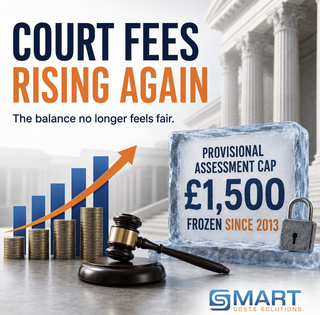
Court Fees are increasing again! The Ministry of Justice has announced a further series of changes to court and tribunal fees, expected to take effect from 13 July 2026, subject to parliamentary approval. The latest package includes increases to 170 fees by 2.6%, reflecting inflation during 2024/25. A further 27 fees will increase by an average of 34% to reflect accumulated inflation, while four fees will be reduced following changes to the underlying cost of the relevant service. For solicitors, clients and legal costs professionals, the individual increases may appear modest in isolation. However, they form part of a much wider pattern. Court Fees have been reviewed and increased repeatedly over the years. Yet the maximum amount recoverable for the work involved in a…
The Danger of Underestimating Costs in Litigation
Wednesday 17th June 2026
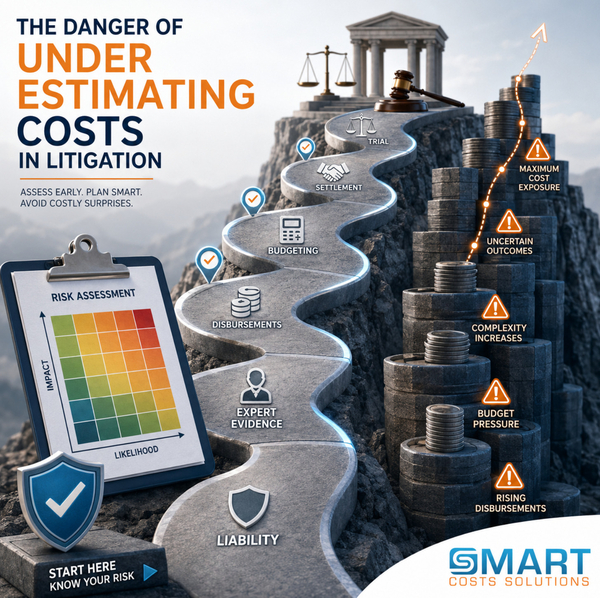
At the beginning of a claim, the focus is usually on liability, evidence and the likely outcome. Does the client have a viable case? What evidence will be required? What is the potential value? How long might the matter take? Those are all essential questions. But there is another question that should be considered from the outset: What is this litigation likely to cost? Underestimating legal costs at the beginning of a claim can create serious problems later. It can lead to unrealistic client expectations, inadequate costs budgets, poor settlement decisions, funding difficulties and pressure on the solicitor client relationship. In some cases, it can affect whether the claim remains commercially sensible to pursue at all. That is why a proper risk assessment at…
Are You Being Let Down by Your Current Costs Specialist?
Monday 15th June 2026
Sonny Welsh

Most firms do not change their costs provider because everything is going well. New clients usually come to us because something has gone wrong. Sometimes the problem is poor advice. A recommendation has been made that later proves difficult to defend, leaving the solicitor exposed to an unfavourable result at assessment. Sometimes the work itself has lacked the necessary detail, judgment or strategic understanding. A bill may have been prepared, but it has not presented the claim properly. Important issues have been overlooked, vulnerabilities have not been identified, or the solicitor has been given unrealistic expectations about recovery. More often than not, however, the biggest complaint is delay. One of our new clients recently told us that their previous costs specialist took three…
Costs in Clinical Negligence Claims: Why Detail Matters
Thursday 11th June 2026

Clinical Negligence claims are rarely simple. Even where the value of the claim appears modest, the work required can be significant. Liability may be complex. Causation may be heavily disputed. Medical records may be extensive. Expert evidence may be required from several disciplines. The client may be vulnerable. The Defendant may take a firm position. The case may require careful investigation long before settlement is achieved. That is why legal costs in Clinical Negligence claims require detail. For claimant solicitors, the focus is understandably on proving the case, supporting the client, obtaining the right evidence, and achieving the best possible outcome. However, when the claim concludes, costs recovery becomes a major issue. The detailed bill, the costs budget, the supporting documents, the…
AI Can Assist, But It Cannot Replace a Good Law Costs Draftsman
Wednesday 10th June 2026
Sonny Welsh

There is no avoiding the conversation about Artificial Intelligence. AI is already changing the way many professional services operate. It can analyse information quickly, assist with drafting, identify patterns, summarise documents, and help streamline tasks that would previously have taken far longer. The legal world will not be immune from that. In fact, costs work may be an area where AI becomes particularly useful. Bills of costs, budgets, schedules, time entries, narratives, correspondence, pleadings, orders, disbursement evidence and assessment documents all involve large amounts of information. Anything that helps organise, review, and process that information more efficiently has the potential to improve how legal costs work is handled. But there is an important distinction between assistance and replacement. AI may help with…
Proportionality in Legal Costs: The Word Everyone Uses but Nobody Loves
Sunday 31st May 2026
Sonny Welsh

Proportionality is one of the most commonly used words in legal costs. It is also one of the most uncomfortable. Everyone understands the basic idea. Costs should not be excessive when compared with what the case was really about. The amount claimed should bear a sensible relationship to the issues, the value of the claim, the complexity of the litigation, the conduct of the parties, and any wider factors involved. In principle, few would argue with that. The difficulty is not the concept. The difficulty is how it works in practice. Proportionality often appears simple when viewed from a distance. A claim settles for a certain sum. The costs claimed are then compared with that sum. If the costs look too high, the…
The Hidden Cost of Leaving Costs Too Late
Wednesday 27th May 2026
Sonny Welsh

In litigation, costs are often treated as something to be dealt with at the end of the case. The claim settles, the order is made, the file is closed, from the fee earner’s perspective, and only then does the question arise “What are we actually recovering?” By that stage, the answer may already have been affected. Costs recovery does not begin when the bill is drafted. It begins much earlier. It starts with how the file is run, how time is recorded, how disbursements are evidenced, how offers are documented, how phases are monitored, and how the overall conduct of the case can later be explained. Leaving costs too late can create problems that are difficult to fix after the event. Time entries…
The Costs Budget Was Approved… So Why Is Recovery Still a Fight?
Thursday 21st May 2026
Sonny Welsh

There is sometimes a misconception that once a costs budget has been approved, the difficult part is over. The budget is agreed or approved, the figures are in place, and everyone can move forward with a degree of comfort about what may be recovered at the end of the claim. Unfortunately, anyone who deals with costs regularly will know that it is rarely quite that simple. An approved costs budget is important. It provides structure, gives the parties a level of certainty, and can have a significant impact on the assessment of future costs. But it does not mean that recovery is automatic. It does not turn every item of work into an untouchable figure. It does not remove the need for…
Proportionality in Legal Costs: A Two-Way Street
Monday 11th May 2026
Sonny Welsh

Proportionality is one of those words that appears constantly in legal costs disputes. It is relied upon in Points of Dispute, raised at assessment, and frequently used as a broad-brush argument to suggest that the receiving party’s costs have simply become “too high” when compared with the damages recovered. That argument can have force. Proportionality is a real, and an important part of costs assessment. The Court is not required to allow costs merely because they were reasonably or necessarily incurred. On the standard basis, CPR 44.3 provides that the court will only allow costs which are proportionate to the matters in issue, and that disproportionate costs may be disallowed or reduced even if they were reasonably or necessarily incurred. But…
‘Hot Coffee’, ‘Fixed Costs’ and the Quiet Price of ‘Reform’
Thursday 7th May 2026
Sonny Welsh

There are some legal stories that take on a life of their own. They stop being legal cases and become cultural shorthand. In the United States, few examples are more famous than the so called ‘McDonald’s hot coffee case’. For years, it was repeated as the ultimate example of a claim gone mad. A woman spills coffee on herself, sues McDonald’s, and walks away with millions. It became a punchline, a political weapon, and a convenient symbol for those who wanted to argue that ‘Civil Justice’ had become excessive, irresponsible and in need of urgent restraint. The documentary ‘Hot Coffee’, released in 2011 and directed by former lawyer Susan Saladoff, set out to challenge that narrative. Rather than treating the case…