



Articles
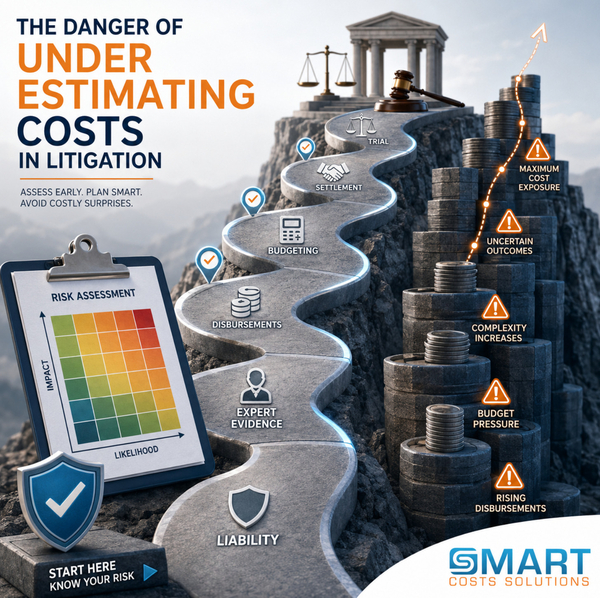
The Danger of Underestimating Costs in Litigation
Wednesday 17th June 2026
At the beginning of a claim, the focus is usually on liability, evidence and the likely outcome. Does the client have a viable case? What evidence will be required? What is the potential value? How long might the matter take?
Those are all essential questions. But there is another question that should be considered from the outset:
What is this litigation likely to cost?
Underestimating legal costs at the beginning of a claim can create serious problems later. It can lead to unrealistic client expectations, inadequate costs budgets, poor settlement decisions, funding difficulties and pressure on the solicitor client relationship.
In some cases, it can affect whether the claim remains commercially sensible to pursue at all. That is why a proper risk assessment at the outset is so important.
Costs Should Form Part of the Initial Risk Assessment
A litigation risk assessment should not focus solely on the prospects of success.
A claim may have strong legal merits but still carry substantial financial risk. The likely costs of investigation, expert evidence, disclosure, witness statements, counsel, interim applications, costs budgeting, mediation and trial preparation all need to be considered.
The potential adverse costs exposure must also be addressed. The client should understand not only what they may recover if successful, but also what could happen if the claim fails, succeeds only in part, or becomes more expensive than originally anticipated.
A meaningful early risk assessment should therefore consider:
• The likely value of the claim.
• The complexity of liability and causation.
• The amount and type of evidence required.
• The likely number of experts.
• The anticipated conduct of the opposing party.
• The possibility of interim applications.
• The funding arrangement.
• The likely recoverable costs.
• The client’s potential shortfall.
• The risk of an adverse costs order.
This does not mean every future cost can be predicted precisely. Litigation is unpredictable by its nature. However, there is a significant difference between accepting that a case may develop unexpectedly and failing to consider costs properly at all.
A Low Value Claim is Not Always a Low Cost Claim
One of the most common mistakes is assuming that a claim with a modest financial value will also be inexpensive to run.
That is not necessarily the case. A relatively modest claim may involve difficult legal issues, extensive disclosure, several witnesses, expert evidence or an opponent who takes every available point.
The cost of doing the work properly may quickly become substantial. This is particularly relevant in clinical negligence, personal injury, professional negligence and other cases where the value of the damages does not always reflect the complexity of proving liability and causation.
A claim may ultimately settle for a modest figure, but only after significant investigation and expert involvement. If the likely costs were underestimated at the outset, the solicitor may later face difficult questions about proportionality, funding and the commercial viability of continuing.
Unrealistic Estimates Create Unrealistic Expectations
Clients rely on their solicitors to give them a realistic understanding of the likely financial position.
If the initial estimate is too low, the client may make decisions based on an inaccurate picture. As the case progresses, the client may then be surprised by increasing costs, additional expert fees or the possibility of a shortfall between the costs incurred and the costs recovered.
That can damage confidence. The client may feel that the case has become more expensive than they were led to believe, even where the work undertaken was entirely necessary.
A realistic estimate at the outset helps manage expectations.
It also creates a clearer basis for reviewing the position as the claim develops. An estimate is not a guarantee. It should be capable of revision where the circumstances change. What matters is that the original assessment was properly considered and that any significant movement is explained promptly.
The Importance of Reviewing/Considering the Opponent’s Likely Approach
The cost of litigation is not determined by one party alone. The conduct of the opponent can have a substantial effect on the work required.
A claim that might have resolved efficiently can become significantly more expensive where liability is denied, disclosure is delayed, allegations are raised late, expert evidence is challenged or procedural applications become necessary.
An early risk assessment should therefore consider how the opposing party is likely to approach the claim.
Is liability likely to be disputed? Will causation be difficult? Is extensive disclosure expected? Is there likely to be a dispute over expert evidence? Could the opponent adopt an aggressive or highly technical approach?
No solicitor can predict the future with certainty, but previous experience and the nature of the dispute may indicate where costs are likely to increase. Those risks should be recognised rather than ignored.
Costs Budgets Must Reflect the Real Case
Underestimating costs can become especially problematic when preparing a costs budget.
A costs budget should not be treated as an exercise in producing the lowest possible figure. Nor should it be based on the hope that the case will progress smoothly. It should provide a realistic and defensible estimate of the work likely to be required.
If a budget is prepared too cautiously, the receiving party may later find that the approved figures do not adequately cover the work needed to progress the claim. That can create problems at recovery.
A solicitor may have undertaken reasonable and necessary work, but if the relevant phase has been exceeded, the receiving party may face an additional hurdle when seeking to recover the excess. The budget assumptions are also critical. They should explain what has been anticipated and help identify when the litigation has moved beyond the basis on which the budget was prepared.
A good costs budget should be realistic, carefully phased and supported by clear assumptions.
It should not simply look attractive at the costs management hearing. It should help protect the client and the firm throughout the litigation.
The Case Must be Monitored as it Develops
A risk assessment carried out at the outset is not the end of the process. Litigation changes.
New evidence may emerge. Liability may become more complicated. Additional experts may be required. The value of the claim may increase or decrease. The opponent may raise issues that were not originally anticipated.
Costs should therefore be reviewed at key stages. That may include:
• After receiving the defence.
• Following disclosure.
• When expert evidence is obtained.
• Before issuing or responding to an interim application.
• Before mediation or settlement discussions.
• When considering a Part 36 offer.
• When the case is approaching trial.
• Whenever there is a significant change in scope.
The reviews are not limited to this list, and regular reviews allow the solicitor to identify whether the original estimate remains realistic.
It also provides an opportunity to update the client, consider the funding position and assess whether the case strategy should change.
Waiting until the end of the claim is too late.
Underestimated Costs Can Distort Settlement Decisions
Costs play an important role in settlement. A solicitor advising on an offer must consider more than the damages figure. The likely costs consequences, future expenditure, litigation risk and potential recoverability all form part of the commercial assessment.
If future costs have been underestimated, an offer may appear less attractive than it really is.
The client may reject a sensible settlement because they have not been given a realistic picture of how much further expenditure will be required to reach trial.
The opposite can also happen. A client may feel pressured to accept an inadequate offer because costs have escalated unexpectedly and the funding position has become difficult.
Accurate costs information supports better decisions.
It allows the solicitor and client to compare the value of settlement with the financial and legal risks of continuing.
Recoverable Costs and Incurred Costs are Not Always the Same
Another danger is assuming that all costs reasonably incurred will automatically be recovered from the opposing party. That is not the case.
Costs may be challenged on the basis of reasonableness, proportionality, hourly rates, duplication, delegation, necessity, phase allocation or compliance with an approved budget.
Some costs may also be irrecoverable between the parties, even though they remain payable by the client under the retainer. The likely gap between costs incurred and costs recovered should therefore form part of the risk assessment.
This is particularly important where the case is valuable to the client for reasons that are not purely financial, or where the work required may be substantial compared with the likely damages.
The client should understand the possibility of a shortfall. The firm should also understand the impact on profitability.
Expert Fees and Disbursements Must be Considered Carefully
Disbursements can make up a significant proportion of the overall costs in complex litigation.
Expert fees, counsel’s fees, court fees, medical records, accident reconstruction evidence, accommodation evidence, care evidence and other specialist reports can all create substantial expenditure.
Those costs should be considered early. Which experts are likely to be required? At what stage should they be instructed? Could more than one discipline be necessary? Will conferences be needed? Is a joint statement likely? Could the expert be required to attend trial?
The cheapest initial estimate is not always the most realistic one. If the case is likely to require substantial expert involvement, that should be recognised from the outset rather than treated as an unexpected development later.
Poor Costs Planning Affects Law Firm Profitability
Underestimating litigation costs does not only create problems for the client. It can also affect the solicitor’s business.
A firm may spend considerably more time on a claim than was originally anticipated. Work in progress may build up. Disbursements may need to be funded. Recovery may be delayed.
The amount eventually recovered may be lower than expected. The result can be a case that succeeds legally but performs poorly commercially.
That is why costs planning is not separate from case management. It is part of it. A properly costed claim allows the firm to allocate resources, monitor work in progress and understand the likely return on the time invested.
It can also identify cases where the economics require particularly careful management.
Early Involvement From a Costs Specialist Can Help
A Law Costs Draftsman or legal costs specialist is often instructed only after a case has concluded. By that stage, many of the important costs decisions have already been made.
Early involvement can provide valuable support. A costs specialist can assist with preparing a realistic costs budget, reviewing assumptions, identifying likely areas of expenditure, monitoring phases and considering the potential recoverability of the work proposed.
They can also help ensure that the costs strategy reflects the litigation strategy. This does not mean that a costs draftsman needs to control the conduct of the case. The solicitor remains responsible for the litigation (as per Mazur).
However, specialist input can help the solicitor understand the potential costs consequences of the decisions being made. That can prevent problems later.
A Risk Assessment Should be Realistic, Not Pessimistic
Proper costs planning is not about discouraging clients from pursuing valid claims. Nor is it about assuming that every case will become difficult or expensive. It is about making informed decisions.
A realistic risk assessment should identify the strengths of the case, the likely challenges, the potential cost, the funding arrangements and the possible outcomes. It should be clear enough to help the client understand the position and flexible enough to be updated as the litigation develops.
The objective is not to predict every event. It is to avoid preventable surprises.
At Smart Legal Costs Solutions, we assist solicitors with costs budgeting, detailed bills, costs drafting, Points of Dispute, Replies, negotiations and detailed assessment proceedings.
We understand that successful costs recovery often begins long before the bill is prepared. It begins with realistic planning, clear advice and a proper assessment of risk.
Underestimating costs can place pressure on the client, the solicitor and the claim itself. Assessing them properly at the outset gives everyone a stronger foundation from which to proceed.
Smart Legal Costs Solutions
Legal Costs - A Smarter Way