



Articles
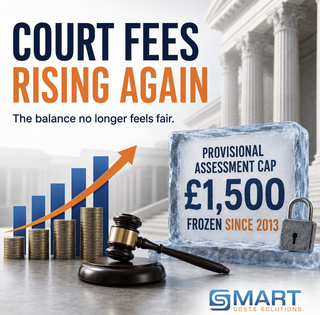
Court Fees Are Rising Again – So Why Is the £1,500 Provisional Assessment Cap Still Frozen?
Tuesday 23rd June 2026
Court Fees are increasing again!
The Ministry of Justice has announced a further series of changes to court and tribunal fees, expected to take effect from 13 July 2026, subject to parliamentary approval.
The latest package includes increases to 170 fees by 2.6%, reflecting inflation during 2024/25. A further 27 fees will increase by an average of 34% to reflect accumulated inflation, while four fees will be reduced following changes to the underlying cost of the relevant service.
For solicitors, clients and legal costs professionals, the individual increases may appear modest in isolation. However, they form part of a much wider pattern.
Court Fees have been reviewed and increased repeatedly over the years. Yet the maximum amount recoverable for the work involved in a provisional assessment has remained fixed at £1,500.00 since the provisional assessment procedure was introduced in April 2013.
That contrast is becoming increasingly difficult to justify.
Which Civil Court Fees are Increasing?
The changes extend across a substantial number of court and tribunal fees. Some of the civil fees most relevant to litigation and legal costs work will increase as follows:
Court Fee Current Fee New Fee
Recovery of land proceedings in the High Court £545 (£559)
Recovery of land proceedings in the County Court £404 (£415)
Claim seeking another remedy in the High Court £646 (£663)
Claim seeking another remedy in the County Court £377 (£387)
Filing proceedings against an unnamed party £67 (£69)
Permission to issue proceedings £67 (£69)
Assessment of costs £67 (£69)
Standard general application on notice £313 (£321)
Standard general application by consent or without notice £123 (£126)
Application to vary a judgment or suspend enforcement £15 (£16)
Issue of a default costs certificate £80 (£82)
Appeal in detailed assessment proceedings £283 (£290)
Application to set aside a default costs certificate £148 (£152)
Request for a fixed costs determination £398 (£408)
Sealing a High Court writ of control, possession or delivery £80 (£82)
County Court warrant of control £94 (£96)
County Court warrant of possession or delivery £148 (£152)
Application for a third-party debt order £135 (£139)
Application for a charging order £135 (£139)
These are only selected examples from the wider package of changes.
Although an increase of £2, £4 or £8 may not appear significant on its own, litigation frequently involves several separate fees. Issue Fees, Application Gees, Hearing Fees, Enforcement Fees and Costs Assessment Fees can all accumulate during the life of a claim.
The latest increases also sit alongside substantial court fees that parties already pay to begin and progress litigation.
Court Fees Have Been Increased Repeatedly
The provisional assessment regime came into force on 1 April 2013. From the outset, the recoverable costs of the assessment were capped at £1,500.00.
Since then, court users have experienced repeated fee increases and upward fee reforms.
On a conservative count, there have been at least seven material rounds affecting Civil Court users since the £1,500.00 cap was introduced:
• broad increases to Civil Court Fees in 2014;
• enhanced Issue Fee changes in 2015;
• increases to Civil Court of Appeal Fees in 2016;
• the removal of online discounts and alignment of online and paper Civil Fees in 2021;
• increases to 172 Court and Tribunal Fees in May 2024, generally by around 10%;
• increases to 171 Court and Tribunal Fees in April 2025, mostly reflecting a further 3.2% inflationary adjustment; and
• the proposed July 2026 increases now announced by the Ministry of Justice.
Not every round affected every Civil Fee, and the nature of the changes has varied. Some were broad inflationary increases. Others changed particular categories, introduced enhanced fees or removed discounts previously available to certain court users.
The overall direction, however, is clear. Where the Government considers the cost of providing court services to have increased, Court Fees are reviewed and adjusted.
The same approach has not been applied to the Provisional Assessment cap.
What Does the £1,500 Cap Actually Cover?
Under CPR 47.15, Provisional Assessment generally applies to Assessment Proceedings in which the costs claimed do not exceed the figure set by Practice Direction 47, currently £75,000.
Where the matter does not go beyond Provisional Assessment, the maximum amount that the court may award to any party for the costs of the assessment is £1,500.00, together with any VAT payable and any Court Fees paid by that party.
It is important to recognise that £1,500.00 is a maximum, not an automatic award.
The court may allow less. The cap governs the recoverable costs of conducting the Provisional Assessment process. That process can include reviewing a substantial bill, preparing detailed Points of Dispute, considering Replies, analysing supporting documents, advising on offers and addressing arguments about hourly rates, proportionality, costs budgeting, phase allocation, duplication, conduct and disbursements.
A Provisional Assessment may take place on paper, but that does not mean the preparation required is simple.
The Cap Has Remained Unchanged for More Than 13 Years
The £1,500.00 figure was selected in 2013. It has not increased since.
During the same period, the cost of employing staff, maintaining offices, purchasing legal technology, securing professional insurance and operating a legal practice has increased considerably.
The complexity of legal costs work has not stood still either. Costs Budgeting is now deeply embedded in civil litigation. Electronic bills have become part of Detailed Assessment practice. Proportionality continues to generate significant disputes. Phase allocation, departures from approved budgets, Part 36 consequences, fixed recoverable costs and increasingly detailed challenges all require careful analysis.
Despite that, the maximum recoverable figure remains exactly where it was in April 2013. In real terms, its value has fallen substantially.
Provisional Assessment Work Still Requires Skill
A Detailed Assessment dispute can materially affect the profitability of the underlying claim.
A receiving party may face challenges to:
• hourly rates;
• the grade of fee earner used;
• the time claimed;
• duplication of work;
• proportionality;
• counsel’s fees;
• expert and other disbursements;
• costs budget phases;
• incurred costs;
• departures from an approved budget;
• the application of fixed costs;
• interest;
• conduct; and
• Part 36 consequences.
Points of Dispute may run to dozens of pages, and raise detailed challenges across hundreds of individual items. Replies must do more than simply state that the work was reasonable.
They may need to explain the procedural history, the complexity of the claim, the conduct of the paying party and the reason particular work was required.
The parties may also need to consider offers, negotiate the bill and advise on whether to accept the provisional assessment or request an oral hearing. The fact that the judge deals with the matter on paper does not eliminate the professional work required before the papers reach the Court.
The Cap Can Influence How Disputes are Conducted
Where the amount reasonably required to prepare and conduct a Provisional Assessment exceeds the recoverable cap, the difference must be absorbed somewhere.
The receiving party may incur a shortfall. The solicitor may have to write off time. A costs specialist may be placed under pressure to carry out substantial work within a figure that no longer reflects current commercial realities.
The cap can also affect the decisions made during negotiation. A party may accept a less favourable offer because the additional cost of continuing the dispute cannot be recovered, even where there are legitimate points still in issue.
That may promote settlement in some cases. However, there is a difference between encouraging proportionate compromise and creating pressure through a cap whose real value has steadily declined for more than a decade.
Should the Cap be Increased?
There is a strong case for reviewing the £1,500.00 figure….. again.
That does not necessarily require removing the cap altogether. Several more proportionate options could be considered.
The cap could be increased to reflect the inflation that has occurred since 2013. It could be reviewed automatically at fixed intervals, in the same way that the Ministry of Justice now proposes to update many court fees routinely.
Alternatively, a tiered system could be introduced, with different caps depending on the amount of the bill or the complexity of the assessment.
A £15,000 bill and a £75,000 bill may both enter provisional assessment, but the work required to deal with them can be very different.
Whatever approach is taken, simply leaving the figure unchanged indefinitely is increasingly difficult to defend.
Inflation Cannot Apply in Only One Direction
The Ministry of Justice’s reasoning for increasing Court Fees is straightforward.
The cost of providing court and tribunal services rises over time. If fees are not adjusted, their real value falls and a greater proportion of the cost must be met elsewhere.
Precisely the same economic logic applies to the £1,500.00 Provisional Assessment cap!
The cap has lost value each year it has remained unchanged. The professional work required has not become cheaper simply because the rule continues to display the same figure. If inflation justifies regular increases to the fees charged by the court, it should at least prompt a review of the amount recoverable by the parties required to use the court’s procedures.
Court Fees will rise again in July 2026. The £1,500.00 provisional assessment cap, meanwhile, remains frozen in 2013!
After more than 13 years, it is difficult to avoid the conclusion that the figure has had its day.
At Smart Legal Costs Solutions, we assist solicitors with detailed bills, Points of Dispute, Replies, costs negotiations, provisional assessments and detailed assessment proceedings.
We understand the importance of handling costs disputes proportionately. But proportionality must work both ways!
Smart Legal Costs Solutions
Legal Costs - A Smarter Way
The July 2026 fee changes remain subject to parliamentary approval. Court users should check the applicable HMCTS fee guidance before filing or issuing any document.